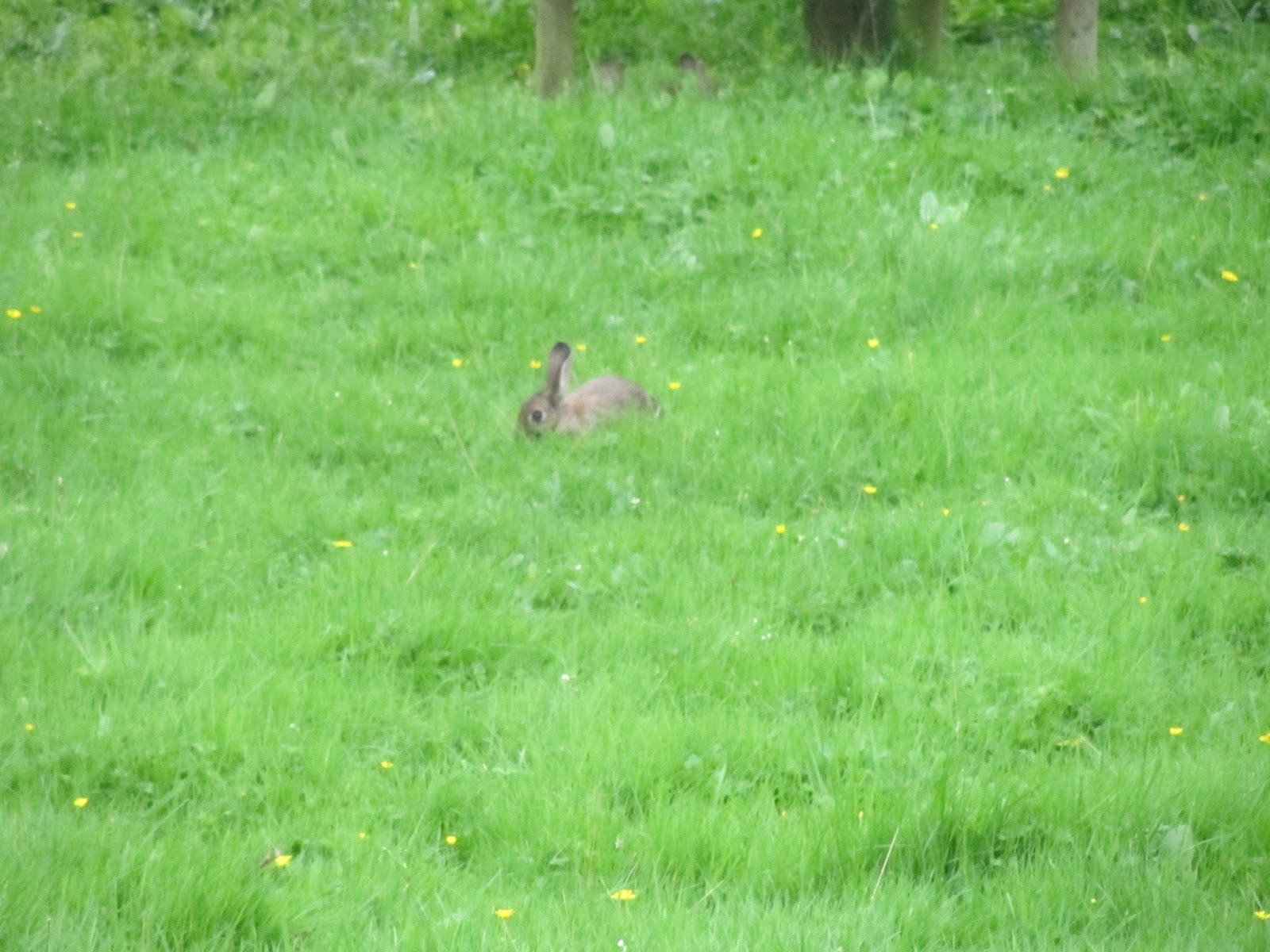
Peter Rabbit that is. Today marks 120th birthday of Peter Rabbit. On today in 1893 Beatrix Potter first told the story of Peter Rabbit in the form of a picture letter to Noel Moore, the son of Beatrix's former governess.
Beatrix had a rabbit she named Peter and that was the inspiration for her letter/story. The book was published in 1902.
Just a fun fact for our British Children's Author study.
Do you have a favorite Beatrix Potter book?
Beth
Wednesday, September 4, 2013
Pooh Sticks
When we were at Hopewell, we had a few minutes to wait for the sand blasting demonstration. Grandma decided it was time to teach the kids how to play Pooh Sticks. There was a small creek with a bridge which was just perfect for playing Pooh Sticks.
Pooh Sticks is the game that Pooh and Christopher Robin play. All you need is a bridge, some sticks, and a creek that moves. You stand upstream and then together everyone drops their stick in the creek. You go to the other side of the bridge and wait to see who is the winner.
I am not sure who won but the kids played a number of time. Miss K found a branch and wanted to use that but we told her that was too big.
I decided this fit in with our British Children's Author study. As we were playing, someone came by and knew what we were doing, playing Pooh Sticks.
Did you know that there are official rules for Pooh Sticks? There is a World Pooh Sticks Championship.
Have you ever played Pooh Sticks?
Beth
Pooh Sticks is the game that Pooh and Christopher Robin play. All you need is a bridge, some sticks, and a creek that moves. You stand upstream and then together everyone drops their stick in the creek. You go to the other side of the bridge and wait to see who is the winner.
I am not sure who won but the kids played a number of time. Miss K found a branch and wanted to use that but we told her that was too big.
I decided this fit in with our British Children's Author study. As we were playing, someone came by and knew what we were doing, playing Pooh Sticks.
Did you know that there are official rules for Pooh Sticks? There is a World Pooh Sticks Championship.
Have you ever played Pooh Sticks?
Beth
Tuesday, September 3, 2013
Hopewell Furnace
We wanted something to do this afternoon and so we decided to go to Hopewell Furnace which is an old iron plantation. It is close to my parents' house so close that we didn't go through any traffic lights but I guess since they live in a rural area that isn't saying much.
Anyway this is an old iron plantation that was in operation 1771 - 1883.
This is a National Historic Site and they have the Jr. Ranger Program. The kids both got the paper to complete the program. I have to say that for J there were quite a bit of questions. He really did have read and pay attention.
Miss K's paper was not as quite as difficult. She did have to find some animals the horses and chickens were easy but the sheep well they were in the field as we drove in and we missed them until we were leaving.
In the furnace they were having a sand blasting demonstration. One of the items that was made here were stoves. They also did make some cannons.
As they were pounding the sand, they asked for volunteers. Miss K was eager to volunteer. I think that might have been therapy.
Daddy even tried his hand to "go pound sand."
There is a water wheel in there.
Miss K was busy in the tenant house -- cleaning the floor
and then in the spring house she was making some butter. Making butter is perfect for her. If you don't know she loves butter. I think she eats bread so she can have the butter. We have found sticks of butter with teeth marks that matched her mouth.
It was a fun afternoon. It was interesting to know that this was beginning production around the same time as the Iron Bridge.
Beth
Anyway this is an old iron plantation that was in operation 1771 - 1883.
This is a National Historic Site and they have the Jr. Ranger Program. The kids both got the paper to complete the program. I have to say that for J there were quite a bit of questions. He really did have read and pay attention.
Miss K's paper was not as quite as difficult. She did have to find some animals the horses and chickens were easy but the sheep well they were in the field as we drove in and we missed them until we were leaving.
In the furnace they were having a sand blasting demonstration. One of the items that was made here were stoves. They also did make some cannons.
As they were pounding the sand, they asked for volunteers. Miss K was eager to volunteer. I think that might have been therapy.
Daddy even tried his hand to "go pound sand."
There is a water wheel in there.
Miss K was busy in the tenant house -- cleaning the floor
and then in the spring house she was making some butter. Making butter is perfect for her. If you don't know she loves butter. I think she eats bread so she can have the butter. We have found sticks of butter with teeth marks that matched her mouth.
It was a fun afternoon. It was interesting to know that this was beginning production around the same time as the Iron Bridge.
Beth
Sunday, September 1, 2013
"I'm Back"
That is what Miss K told her aunts and uncles when she saw them on Friday. She was so excited to go home which at this time was going to Grandma's house.
But first we had to do all the packing. Why is it that things always seem to expand when you are packing at the end of the trip? We walked through the house where we were staying and found this animal that tried to stay behind. We grabbed him and stuffed him in the suitcase. We didn't want him to have to stay until we return in January.
We flew home via Iceland as Icelandair had the best price. We did have a layover there in Reykjavik. Here is the view as we were coming into the airport.
I will say that the air was nice and clean. We did learn from reading the inflight magazine that winter is not as cold as you might think. We walked off the plane into the airport and our flight was taking off at the next gate and we had an hour till the next flight was taking off.
Icelandair was good. One of the things that they learned from the US airlines is to charge for meals. So if I were flying Icelandair again, I would pack a lunch. Then again the cost of the meal we purchased was less than the difference in the cost of tickets on another airline. They did give the kids meals so that is nice.
We are back here spending some time with family before we head on.
Beth
But first we had to do all the packing. Why is it that things always seem to expand when you are packing at the end of the trip? We walked through the house where we were staying and found this animal that tried to stay behind. We grabbed him and stuffed him in the suitcase. We didn't want him to have to stay until we return in January.
I will say that the air was nice and clean. We did learn from reading the inflight magazine that winter is not as cold as you might think. We walked off the plane into the airport and our flight was taking off at the next gate and we had an hour till the next flight was taking off.
Icelandair was good. One of the things that they learned from the US airlines is to charge for meals. So if I were flying Icelandair again, I would pack a lunch. Then again the cost of the meal we purchased was less than the difference in the cost of tickets on another airline. They did give the kids meals so that is nice.
We are back here spending some time with family before we head on.
Beth
Tuesday, August 27, 2013
The Iron Bridge
This is not just any bridge but the first arch bridge to be made from cast iron. Construction on the bridge began in 1775 so while over in America the Revolution was beginning to brew here was a bridge that was being built.
There was a new blast furnace nearby lowered the cost of iron and allowed engineers to consider new options for construction.
The bridge cost just about £6,000 to build which would be about £1.5 million in today's money. Abraham Darby who was the grandson of the foundry was commissioned to cast and build the bridge. He estimated that it would cost £3,200 which was raised and said he would fund any excess. That might not have been the right thing to say. He ended up funding the excess and was in debt for the rest of his life.
This bridge was also important in that it was the beginning of the Industrial Age. The bridge claims to be the birthplace of the Industrial Revolution. In the small museum at the Toll House there was a copy of a painting that was found in 1997 of the bridge while it was being built.
Back in the old days until 1950 it cost to cross the bridge. Now you can walk across for free.
We enjoyed our time there and walked a bit about the town. There are a number of museums that you can go through but we decided not to do that today.
Beth
Monday, August 26, 2013
Recent Reading
I thought I would share a bit of what I have been reading recently. As we were leaving Asia, I picked up a book, Not Less Than Everything by Valerie Griffiths.
Here is the summary from Amazon, "The book traces the stories of some of the early women missionaries in China who tried to tackle the painful custom of foot-binding. Often struggling with poor health, isolation and criticism from the expatriate community, the women of the China Inland Mission pioneered initiatives into the vast interior."
The book began with the early women missionaries to China beginning with Maria Tarn Dyer who sailed to Penang in 1827. Her daughter, Maria, married Hudson Taylor. Susie Garland was a new person to read about. She was from Australia. She was concerned about the blind people and so she developed a new way to teach blind Chinese to read. The Trio was about group of women, Mildred Cable and sisters, Eva and Francesca French spent 20 years in one area and then later in life began traveling along The Silk Road. The book went on through to the 1950's and Phyllis Thompson.
I started and finished the book on our flight from Asia to England. It was about a 12 hour flight so that does give plenty of time to read and the book was written in such a way that I wanted to keep reading. The book also made me want to read more about the Trio especially Mildred Cable.
When I arrived here and wanted something else to read, I picked up a copy of Mountain Rain: A New Biography of James O. Fraser by Eileen Crossman. I had heard about J. O. Fraser and his work among the Lisu people. I had watched Breakthrough the other year.
Here is the summary from Amazon, "James Fraser was only twenty-two when he abandoned a promising career and went to China. At first sight of the Lisu tribes people of Yunnan province he felt an immediate affection for them, and for the rest of his life he labored to bring them to Christ and to Christian maturity. Packed with personal letters, insightful anecdotes and riveting stories of missionary life in China, this superb biography by Eileen Crossman, his daughter, shines with God's constant faithfulness and power over evil."
This book was not as easy to read as Not Less Than Everything based on the fact that it took me longer to read. Some might have been the writing style and some was the fact that I felt there were parts of the story that were missing that I would have liked to know. I did come away from the book aware of J.O. Fraser's dedication to the Lisu people and the difficult task of living, working, and traveling in such a difficult area. He also felt strongly that prayer was what was going make the difference in the work. There are a number of quotes from him are prayer that personally remind me of the importance of that in our daily life.
One quote in the book that really encouraged me was, "James believed it was no more necessary to be faithful in preaching the Gospel than in doing something like washing up dishes in the kitchen. 'I am no more doing the Lord's work in giving the Word of God to the Chinese,' he wrote, 'than you are, for example, in wrapping up a parcel to send to the tailor. It is not for us, . . . to choose our work. And if God has chosen it for us, hadn't we better go straight ahead and do it, without waiting for anything greater, better or 'nobler'."
The last book on my stack of recently read books, is The Power to Save: A History of the Gospel in China by Bob Davey. The book begins with the Nestorians and some of the Catholic mission work. That is just given as background and the book is clear that Catholic and Protestant are not the same. In September 1807 is when Robert Morrison arrived. The book continues giving various key people and events in China both with missionaries and with the Chinese believers. This book condenses almost 200 years of history into about 300 pages. It is a good overview and history of missions in China.
Yes, there is a Chinese theme to what I have been reading. These are just various books that I picked up to read. These are just my comments on what I was reading. I was invited to spend time in the CIM archives and do more reading. I realize the sacrifice, the dedication, and the love for God and the Chinese people that so many of the early missionaries had.
Just sharing a bit of what I have been reading. We have another flight this week. I guess I will need to find a book or two to read though it is not as long of a flight.
Beth
Saturday, August 24, 2013
Hill Top Farm
Since we were in the Lake District, we decided to go home via Hill Top Farm. We wanted to visit based on our British Children's Author study of Beatrix Potter. It helped that we had seen the movie, Miss Potter. Hill Top is the first farm that Beatrix purchased. She went on to buy a number of other farms.
One totally interesting fact about Hill Top if that 20% of their visitors are from Japan. The brochures were in Japanese and you could buy some books in Japanese. Miss Potter has quite a following there. I do remember being in Asia and see quite a bit of Beatrix Potter things.
We drove through some windy, narrow roads. We saw a lots of hills and fields with sheep. Miss Potter's favorite breed was Herdwick which she helped save this breed from extinction. She was very involved in farming in the Lake District. She was named President-elect of the Herdwick Sheepbreeders' Association, the first time a woman had ever been elected to that office but died before taking office.
We walked through the garden which was not that big. Hill Top is still a working farm.
There was a grassy field and we counted about four rabbits in there. Beatrix Potter wrote Peter Rabbit before moving to Hill Top. It was from the earnings from Peter Rabbit and four other books that she was able to buy Hill Top.
There was a small vegetable garden which reminded us of Mr. McGregor's garden. We even found a watering can in the garden.
Within the first two years of living at Hill Top Farm, Beatrix had 96 rats in her house. I think those rats were inspiration for the book The Tale of Samuel Whiskers.
When Miss Potter lived here, there was no electricity and running water even though it was available in the village. They did have electricity now and kept the lights low so it had the same feel as when she lived there. She was the last person to live there and left the house to the National Trust for tours. As we entered the house we were given a copy of The Tale of Samuel Whiskers and were told to look at various places in the house to find the actual parts of the house that were the inspiration for the book. We saw the front door, the fireplace and a number of other places.
This was the gate that you see in Tom Kitten.
Here is Mr. McGregor and you can even see Peter Rabbit in the water can.
I am amazed at all the places where I have seen mailboxes even in small little villages. This was in the village but was also in one of the books.
Would you like a post card from here, I have an extra one or two. The first two people to let me know and make sure I have your address, will get one.
I am glad that we stopped. It was worth the drive. We then drove back south to where we were staying and took a ferry across one of the lakes in the Lake District. The bridges in Seattle were longer than the span where we took the ferry but it was a fun experience and saved having to drive on narrow, windy roads.
Beth
One totally interesting fact about Hill Top if that 20% of their visitors are from Japan. The brochures were in Japanese and you could buy some books in Japanese. Miss Potter has quite a following there. I do remember being in Asia and see quite a bit of Beatrix Potter things.
We drove through some windy, narrow roads. We saw a lots of hills and fields with sheep. Miss Potter's favorite breed was Herdwick which she helped save this breed from extinction. She was very involved in farming in the Lake District. She was named President-elect of the Herdwick Sheepbreeders' Association, the first time a woman had ever been elected to that office but died before taking office.
We walked through the garden which was not that big. Hill Top is still a working farm.
There was a grassy field and we counted about four rabbits in there. Beatrix Potter wrote Peter Rabbit before moving to Hill Top. It was from the earnings from Peter Rabbit and four other books that she was able to buy Hill Top.
There was a small vegetable garden which reminded us of Mr. McGregor's garden. We even found a watering can in the garden.
Within the first two years of living at Hill Top Farm, Beatrix had 96 rats in her house. I think those rats were inspiration for the book The Tale of Samuel Whiskers.
When Miss Potter lived here, there was no electricity and running water even though it was available in the village. They did have electricity now and kept the lights low so it had the same feel as when she lived there. She was the last person to live there and left the house to the National Trust for tours. As we entered the house we were given a copy of The Tale of Samuel Whiskers and were told to look at various places in the house to find the actual parts of the house that were the inspiration for the book. We saw the front door, the fireplace and a number of other places.
This was the gate that you see in Tom Kitten.
Here is Mr. McGregor and you can even see Peter Rabbit in the water can.
I am amazed at all the places where I have seen mailboxes even in small little villages. This was in the village but was also in one of the books.
Would you like a post card from here, I have an extra one or two. The first two people to let me know and make sure I have your address, will get one.
I am glad that we stopped. It was worth the drive. We then drove back south to where we were staying and took a ferry across one of the lakes in the Lake District. The bridges in Seattle were longer than the span where we took the ferry but it was a fun experience and saved having to drive on narrow, windy roads.
Beth
Subscribe to:
Posts (Atom)